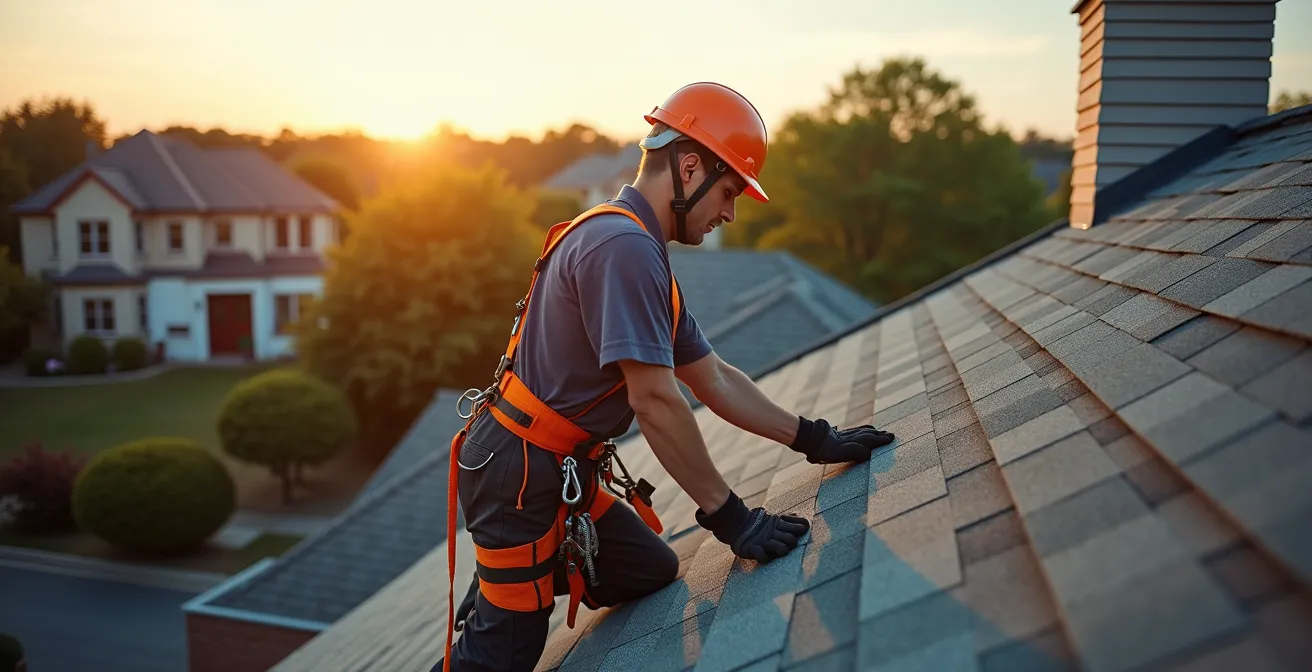
Standing at the base of a house with a steep roof, many homeowners wrestle with a familiar calculus: hire professionals at premium rates, or tackle the project themselves with rented equipment and determination. The decision feels straightforward until you understand what professional roofers know from daily experience—that steep slopes don’t just add difficulty, they fundamentally transform the physics of safety in ways that make equipment non-negotiable.
Professional roofing contractors approach steep slope work with systematic equipment deployment that might seem excessive from ground level. Yet this apparent overcaution masks a sophisticated understanding of exponential risk multiplication, economic realities, and human psychology that makes cutting corners not just dangerous, but financially irrational.
The gap between professional practice and DIY confidence reveals a complete safety ecosystem built on physics, profit calculations, and redundant protection layers. Understanding this system explains why experienced roofers never skip equipment—and why homeowners who recognize these realities make fundamentally different decisions about steep slope work.
Professional Roofing Safety in 5 Key Points
- Steep slopes multiply danger exponentially through physics, not linearly through perception
- Safety equipment generates profit for professionals through productivity and insurance savings
- Cognitive biases systematically cause homeowners to underestimate actual risk levels
- Modern systems integrate redundant protection layers that account for human error
- Accident consequences cascade far beyond immediate injury into project failure and liability
The Hidden Physics: Why Steep Slopes Multiply Risk Exponentially, Not Linearly
When roof pitch increases from 4/12 to 8/12, most people assume danger doubles. The mathematical reality tells a different story. Gravitational force vectors don’t scale linearly—they compound exponentially as angles steepen, transforming manageable body weight into uncontrollable downward force that overwhelms human strength and balance.
The critical threshold where friction fails varies by material, but the pattern remains consistent across all roofing surfaces. Asphalt shingles, metal panels, and tile all reach a tipping point where grip coefficient degrades faster than slope angle increases. Research into snow retention demonstrates that snow is very likely to slide on slopes approaching 45 degrees (12/12 pitch), revealing the same friction breakdown that affects human footing.
| Roof Pitch | Force Down Slope | Friction Available | Safety Factor |
|---|---|---|---|
| 4/12 (18.4°) | 31% body weight | High grip | Manageable |
| 8/12 (33.7°) | 55% body weight | Moderate grip | Challenging |
| 12/12 (45°) | 71% body weight | Minimal grip | Critical |
These percentages reveal why an 8/12 pitch isn’t twice as dangerous as 4/12, but rather five to seven times more hazardous. At 31% body weight forcing you downward, muscle tension and careful foot placement provide adequate control. At 55%, that same body generates nearly double the sliding force while available friction decreases simultaneously—a compound effect that transforms the safety equation.
Engineering analysis of steep slope forces confirms this exponential progression through rescue operation calculations. The physics governing safe movement on angled surfaces follows predictable mathematical relationships that human intuition consistently misreads.
Professional roofers internalize these force calculations through experience, recognizing that past a certain angle threshold, no amount of strength or caution compensates for mechanical disadvantage. The point of no return arrives when gravitational pull exceeds friction coefficient—a moment where self-arrest becomes physically impossible regardless of fitness level or technique.
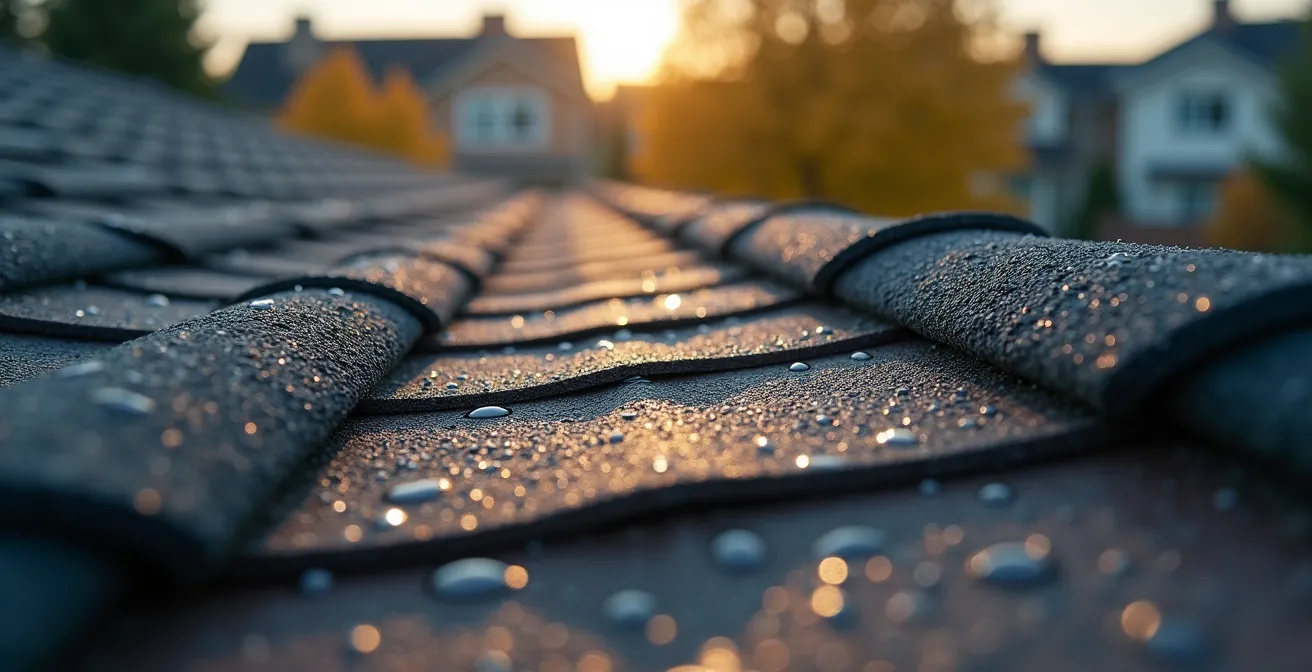
Weather conditions compound these base physics risks exponentially rather than additively. Morning dew reduces friction coefficients by 40-60% within minutes. A surface manageable at 8/12 pitch in dry conditions becomes critically dangerous at the same angle with moisture present. Temperature shifts cause expansion and contraction that create debris accumulation in micro-valleys, further degrading grip. Wind loading adds lateral forces that combine with downslope pull, creating vector forces at unpredictable angles.
The Professional’s Economic Equation: Safety Equipment as Profit Center, Not Cost
Most discussions of roofing safety equipment frame the investment as regulatory compliance or ethical obligation—a necessary cost of doing business. Professional roofing companies with established safety programs understand a different financial reality: comprehensive equipment directly generates profit through multiple revenue channels that dwarf the initial capital outlay.
The direct cost impact appears first in insurance differentials. Falls from elevations cost insured roofers $54 million annually, driving workers’ compensation premiums that can exceed 30% of payroll for companies with poor safety records. Firms demonstrating comprehensive fall protection systems through equipment investment and training documentation negotiate premium reductions of 25-40%, converting safety spending into immediate operational savings.
Industry adoption patterns reveal this economic logic in practice. Current data shows 83% of contractors provide all safety equipment to their workers, a percentage that correlates directly with company longevity and profitability metrics. The remaining 17% operating without full equipment systems concentrate in startup and marginal operations with higher failure rates.
The productivity multiplier represents the most significant but least visible profit driver. Proper fall protection allows roofers to move confidently on steep slopes without the hesitation and careful testing that consumes time on every step. Workers secured by integrated harness systems can use both hands for precision work instead of maintaining constant three-point contact. This confidence translates into documented productivity gains of 30-40% on steep slope projects, effectively allowing four-person crews to accomplish five-person output.
| Investment Area | Cost Impact | Productivity Gain |
|---|---|---|
| Fall Protection Systems | -$3,000 initial | +30-40% speed on slopes |
| Workers’ Comp Premium | -25% with safety program | Reduced downtime |
| Talent Retention | -$15,000 per replacement | Experienced crew efficiency |
| Quality/Callbacks | -$2,000 per incident | Two-handed precision work |
Talent acquisition and retention create another profit channel through reduced replacement costs. Skilled roofers gravitate toward employers providing comprehensive safety equipment, recognizing that their long-term earning capacity depends on avoiding career-ending injuries. The replacement cost for experienced workers averages $15,000 when factoring in recruiting, training, and the productivity gap during skill development. Companies maintaining full safety programs reduce turnover by 40-50% compared to equipment-minimal competitors.
Quality impact monetization appears in callback reduction and warranty claim avoidance. Roofers working from stable positions with proper fall arrest backup can maintain consistent fastening patterns, proper overlap sequences, and precise flashing integration. Rushed work from compromised positions—the inevitable result of working without adequate protection—generates leak points that manifest as callbacks within the first year. Each callback incident costs $2,000-5,000 in materials, labor, and reputation damage that safety equipment prevents through enabling proper technique.
Essential Equipment ROI Calculation Factors
- Calculate productivity multiplier from confident movement versus hesitation
- Compare insurance premiums with versus without comprehensive safety programs
- Factor skilled worker replacement costs at $15,000+ per position
- Include callback reduction from stable working positions
- Account for expanded bidding opportunities on steep slope projects
Cognitive Blind Spots: Why DIYers Systematically Underestimate Steep Slope Danger
The disconnect between professional safety practices and homeowner confidence stems from predictable psychological mechanisms rather than personal recklessness. Cognitive biases that serve humans well in most contexts become dangerous liabilities when evaluating steep slope risk, creating systematic underestimation that no amount of good intentions can overcome.
Optimism bias drives the planning fallacy that characterizes most DIY steep slope attempts. People consistently overestimate their ability to remain careful and underestimate how quickly conditions deteriorate. The internal narrative—”I’ll just be extra cautious”—ignores research showing that sustained vigilance degrades after 20-30 minutes of cognitive load, exactly when roof work demands peak attention. Weather shifts, material discoveries, and physical fatigue compound exactly when mental reserves deplete.
The false familiarity effect creates particularly dangerous confidence among homeowners who have successfully completed ground-level or low-slope projects. Successfully installing a patio or re-shingling a garage with a 3/12 pitch generates competence memories that the brain incorrectly applies to steeper work. The skills transfer incompletely—what worked at 18 degrees fails catastrophically at 35 degrees—but the confidence transfers completely, creating maximum danger at minimum skill.
Statistical analysis of accident patterns confirms these psychological mechanisms translate into predictable injury concentrations. Data reveals over 97 percent of roofing-related accidents happen at home, demonstrating that professional worksites with trained crews and systematic equipment deployment operate at fundamentally different risk levels than DIY attempts by confident homeowners.
Gradualism and adaptation mask immediate danger through neurological accommodation. Climbing onto a steep roof doesn’t trigger instant alarm because the body adapts to the angle over 30-60 seconds, normalizing the sensation of precariousness. This adaptation period creates false security—”This isn’t so bad”—that persists until a single slip reveals the actual physics. The gap between perceived stability and actual danger widens as adaptation deepens, making the first 15 minutes the most dangerous despite feeling increasingly comfortable.
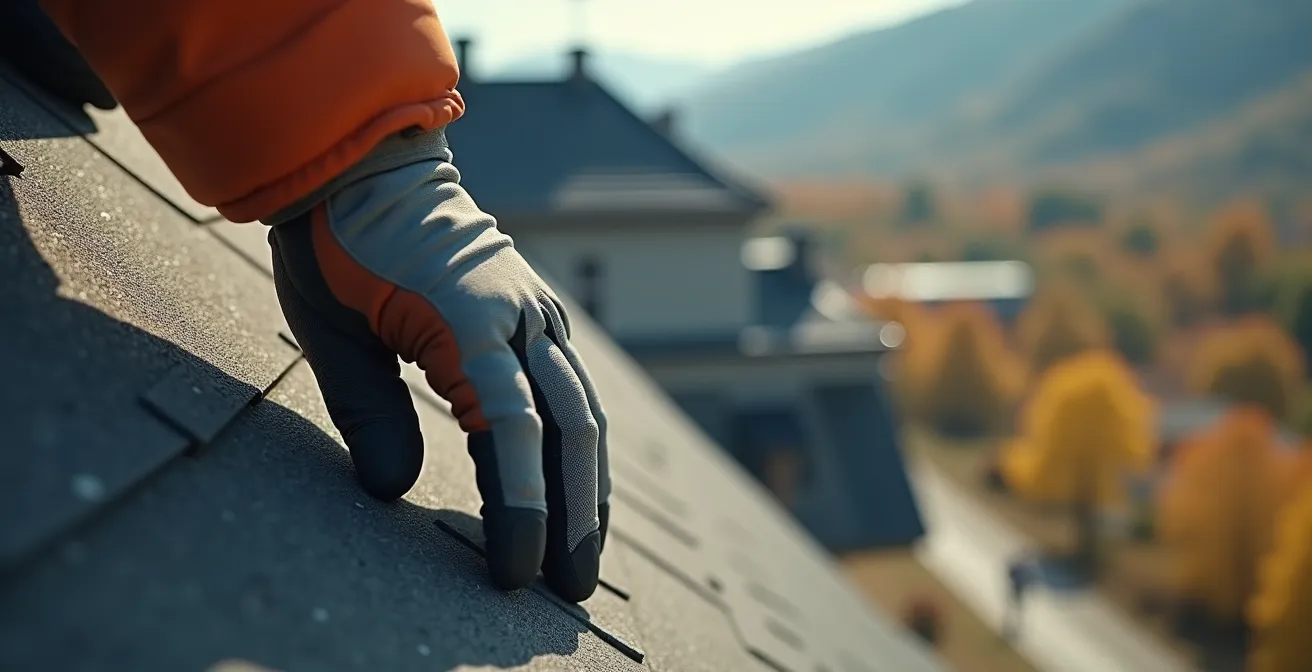
The visibility bias of safety equipment compounds these internal miscalculations through external misperception. Watching professionals work from ground level makes harnesses and anchor systems appear excessive because the observer cannot see the dozens of micro-slips and balance corrections the equipment prevents hourly. Each near-miss that safety gear catches invisibly reinforces the ground observer’s belief that such protection remains unnecessary for “careful” work, when the equipment’s primary function involves managing the careful worker’s inevitable small errors before they cascade into falls.
Professional roofers develop calibrated risk perception through accumulated near-miss exposure that homeowners never acquire. After the fifth time a harness catches a slip that would have meant a fall, or the tenth instance where an anchor point prevents a slide into a valley, the equipment shifts from burden to necessity in the worker’s mental model. DIY workers never accumulate this experiential recalibration, maintaining dangerously optimistic assessments throughout their limited exposure.
Integrated Safety Systems: How Modern Equipment Creates Redundant Protection Layers
Professional approaches to steep slope safety have evolved beyond simple equipment checklists into engineered systems thinking. The difference between owning a harness and deploying an integrated fall arrest system parallels the gap between possessing ingredients and executing a recipe—individual components matter far less than their systematic integration and redundant backup layers.
The primary-secondary-tertiary protection model structures how professionals layer defenses so that failure at any single level activates the next tier rather than causing catastrophe. Primary prevention includes physical barriers like toe boards, guardrails, and designated walkways that prevent workers from approaching edge hazards. Secondary arrest systems—harnesses connected to engineered anchor points through shock-absorbing lanyards—catch workers if primary barriers fail. Tertiary mitigation involves rescue plans, medical response protocols, and equipment designed to minimize injury severity if a fall occurs despite the first two layers.
Regulatory frameworks recognize this systems approach by mandating performance standards rather than specific equipment. OSHA requirements specify that anchor points must support 5,000 pounds as part of engineered fall arrest systems, reflecting dynamic load calculations that account for fall distance, worker weight, and deceleration forces. Meeting this standard requires engineering the complete system—anchor point placement, connection hardware ratings, and shock absorber specifications—as an integrated unit rather than assembling components individually.
Modern implementation combines permanent installations with portable protection systems to address varying site conditions. Professional contractors increasingly install permanent lifeline systems on complex residential roofs, providing continuous anchor points that eliminate the setup time and connection gaps that characterize temporary systems. When permanent protection isn’t feasible, pre-assembled personal protective equipment sets ensure proper component integration through factory testing rather than field improvisation.
Multi-Layered Fall Protection Implementation Analysis
Contemporary safety systems integrate permanent lifeline installations with personal protective equipment sets containing proper anchorage (A), body support (B), and connection (C) components that arrive pre-assembled for immediate compliance. This approach eliminates the dangerous gap between owning individual components and deploying them as an engineered system, ensuring that workers connect to tested, certified protection rather than improvising connections that may fail under dynamic loads.
Environmental integration requires adapting safety systems to specific roof materials, weather conditions, and architectural features that create unique hazards on each project. Metal roofs demand different anchor point solutions than asphalt shingle or tile installations. Valley intersections, chimney penetrations, and skylight frames create fall hazards that standard perimeter protection doesn’t address, requiring supplemental anchor points and designated pathways. Professionals conduct site-specific hazard assessments before beginning work, mapping protection requirements to actual conditions rather than applying generic solutions.
| Protection Layer | Components | Function |
|---|---|---|
| Primary Prevention | Guardrails, toe boards, walkways | Physical barriers preventing approach to edges |
| Secondary Arrest | Harnesses, lifelines, anchor points | Catches worker if primary fails |
| Tertiary Mitigation | Shock absorbers, rescue plans | Reduces injury if fall occurs |
Communication and coordination protocols represent the often-invisible safety layer that completes the physical systems. Effective leadership and management skills enable crew chiefs to maintain spotter systems, establish signal protocols for equipment adjustments, and ensure rescue readiness throughout steep slope work. These human factors transform individual protection into team safety, catching errors before they reach the equipment’s physical intervention threshold.
The expertise gap between equipment ownership and system deployment explains why DIY workers remain at severe risk even when they rent or purchase individual safety components. A homeowner with a harness, rope, and roof anchor possesses three items, not an integrated fall arrest system. Without understanding dynamic load paths, proper connection sequences, or rescue protocols, those components provide false security that may prove more dangerous than acknowledged vulnerability.
Modern tracking and documentation systems close the loop by ensuring equipment maintenance, inspection schedules, and replacement protocols that keep protection systems functional over time. Professional operations implement project management tools that track harness inspection dates, anchor point load testing, and component retirement schedules, preventing the gradual degradation that turns certified equipment into unreliable protection. This systematic approach to equipment lifecycle management represents another dimension of professional practice that DIY efforts cannot replicate.
Critical System Integration Points
- Verify anchor points rated for dynamic loads based on fall distance calculations
- Ensure harness compatibility with shock-absorbing lanyards for slope angles
- Establish communication protocols with designated spotters
- Position rescue equipment and trained personnel before work begins
- Test all connection points for proper engagement before loading
Key Takeaways
- Steep slope physics creates exponential risk multiplication that human strength cannot overcome
- Professional safety equipment generates measurable profit through productivity gains and insurance savings
- Predictable cognitive biases cause systematic danger underestimation in DIY steep slope work
- Modern protection integrates redundant layers where single-point failures cannot cause catastrophic outcomes
- Accident consequences cascade through project abandonment, liability exposure, and long-term disability costs
The Cascade Effect: True Cost of Steep Slope Accidents Beyond the Injury
Traditional safety discussions focus on immediate injury—broken bones, head trauma, spinal damage from impact. This narrow framing misses the cascade of consequences that flow from steep slope accidents, creating compounding costs that extend years beyond the fall itself and affect far more than the injured worker’s body.
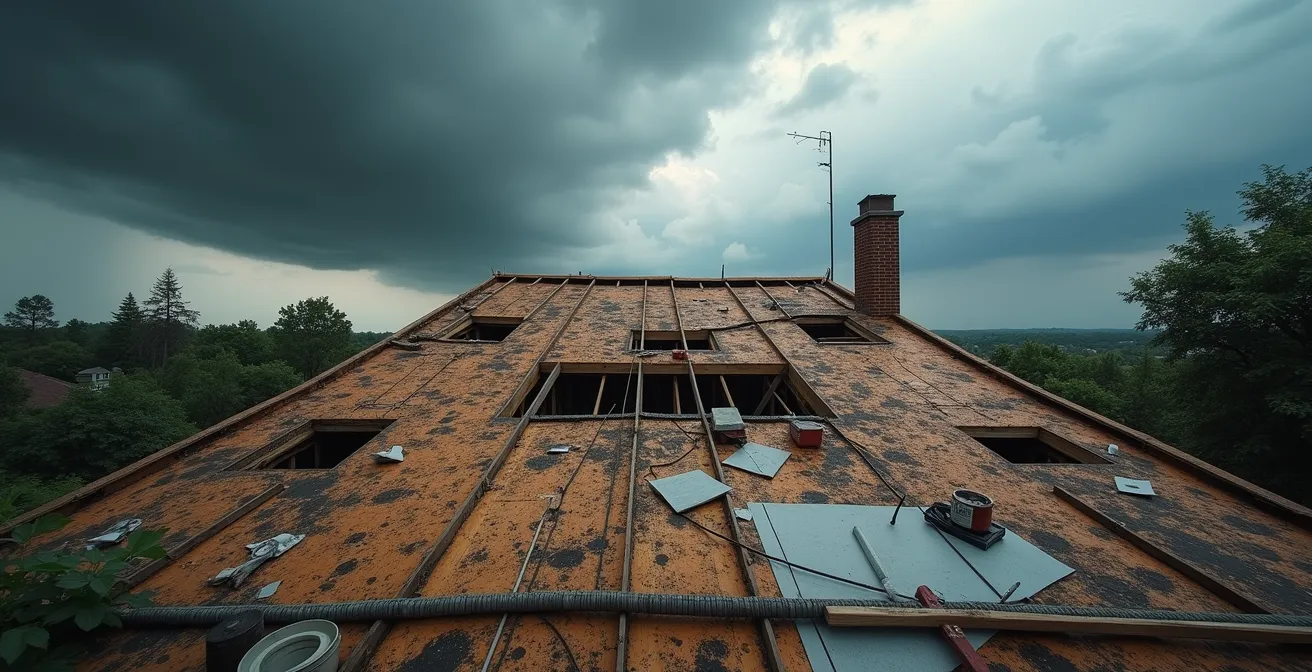
Project failure cascade begins the moment an accident occurs. DIY steep slope injuries typically leave roofs in worse condition than before work started, with torn-off sections exposing structural decking, scattered materials creating additional hazards, and compromised waterproofing that admits weather damage. The injured homeowner now faces emergency repair costs to weatherproof the structure—often $5,000-15,000 for professional intervention to tarp and stabilize—before addressing the original roofing need. These emergency costs occur precisely when medical bills and lost wages strain household finances most severely.
Economic impact analysis reveals the compounding nature of these costs. Industry data shows roof repair and replacement costs hit nearly $31 billion in 2024, a 30% increase since 2022, driven partially by emergency interventions following failed DIY attempts. When homeowners attempt steep slope work without proper protection and suffer accidents, they convert planned maintenance into crisis response at 3-5 times the original professional installation cost.
Legal and liability exposure creates another cascade branch that most DIY workers never consider until facing it. Homeowners bear direct responsibility for injuries to helpers, friends, or family members assisting with roof work. A friend who falls while helping with a steep slope project can sue for medical costs, lost wages, and pain and suffering, with homeowner’s insurance potentially declining coverage for injuries arising from work that should have required professional licensing. Property damage to neighbors from falls, dropped materials, or project abandonment adds additional liability vectors.
Cascade Impact Analysis of DIY Roofing Failures
Documentation of DIY steep slope accidents reveals a consistent pattern where initial medical expenses and lost wages represent only 20-30% of total costs. The majority of financial impact stems from emergency roof weatherproofing, professional repair of DIY damage, legal settlements with injured helpers, home value reduction from incomplete permitted work, and long-term disability costs that compound over decades. Homeowners attempting to save $8,000-12,000 on professional installation frequently face total costs exceeding $150,000 when the full cascade plays out over 2-3 years following an accident.
Long-term disability economics transforms temporary savings into permanent financial burden. Roof falls from steep slopes commonly cause back injuries, knee damage, or neurological trauma that creates 20-30 year impacts on earning capacity. A 45-year-old homeowner who suffers a fall resulting in chronic back pain faces potential earnings losses of $400,000-800,000 over their remaining work life, dwarfing any savings from DIY approaches. Disability insurance rarely covers injuries from voluntary steep slope work without proper safety equipment, leaving families to absorb the full impact.
Roof quality degradation represents the subtlest but most insidious cascade effect. Working on steep slopes without adequate safety equipment forces compromised installation techniques—rushing to minimize exposure time, poor body positioning that prevents proper fastening, incomplete overlap sequences from unstable footing. These shortcuts create leak points and premature failure that manifest 2-5 years after installation, requiring complete replacement rather than simple repair. The connection between safety shortcuts and roof performance closes the loop: attempting to save money by skipping professional safety systems ultimately costs more through accelerated roof failure.
Hidden Costs of Steep Slope Accidents
- Emergency roof tarping and weatherproofing: $2,000-5,000
- Property damage from incomplete work exposure: $10,000-50,000
- Legal liability for helper injuries: $100,000+
- Lost wages during recovery: $30,000-80,000 annually
- Home sale complications from permit violations: 10-20% value reduction
The cascade framework reveals why professional roofers approach steep slopes with systematic equipment deployment that might appear excessive in isolation. Each safety measure addresses not just immediate fall prevention but cascade interruption—stopping the branching consequences before they multiply beyond control. This comprehensive risk assessment, grounded in physics, economics, psychology, and systems engineering, makes equipment investment not just prudent but economically rational for anyone who understands the complete cost structure.
Homeowners who grasp this cascade logic make fundamentally different decisions about steep slope work. The choice transforms from “professional installation versus DIY with rented equipment” into “systematic risk management versus exposure to compounding consequences.” Viewed through this expanded frame, professional services with integrated safety systems represent not premium pricing but appropriate cost allocation for comprehensive risk transfer—exactly the calculation that professional roofers make every day.
Frequently Asked Questions on Roofing Safety
Why do homeowners think they can safely work on steep roofs?
Homeowners often succeed with ground-level or low-slope projects, creating false confidence. This familiarity effect masks how exponentially more dangerous steep slopes become, as skills from 18-degree work do not transfer to 35-degree surfaces despite the confidence carrying over completely.
What makes professional roofers different psychologically?
Professionals have witnessed near-misses and understand that safety equipment prevents dozens of micro-corrections daily that would otherwise lead to falls. This experiential recalibration—developed through accumulated exposure to what the equipment actually catches—fundamentally changes risk perception in ways DIY workers never develop.
How quickly can conditions change on a steep roof?
Morning dew, temperature changes, or slight wind can transform a manageable surface into a hazardous one within minutes, before neurological adaptation occurs. Weather shifts compound base physics risks exponentially, reducing friction coefficients by 40-60% while workers experience false security from initial adaptation to the angle.