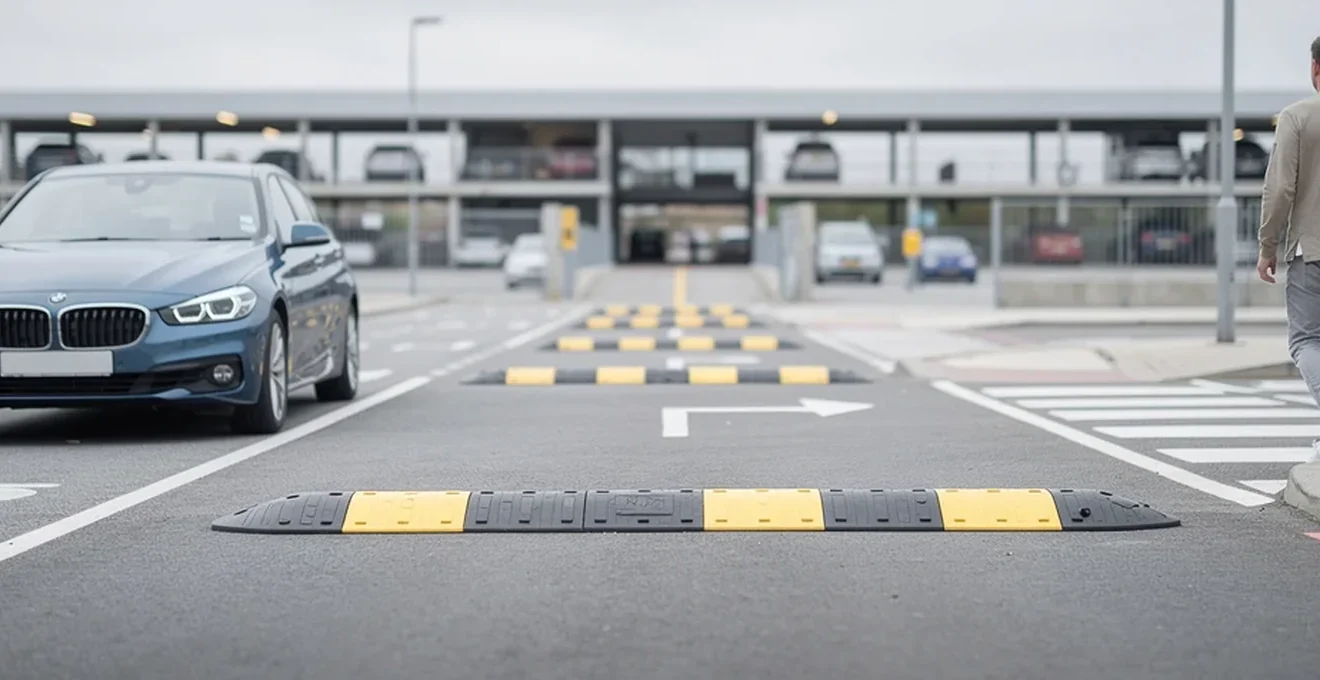
Car parks bring together vehicles, pedestrians and pushchairs in a confined space, often with poor sightlines around parked cars and structural columns. Speed bumps remain one of the simplest and most reliable ways to keep vehicle speeds low enough for everyone to react safely. But not every raised surface performs the same job: a cheap moulded ramp bought for a small trade car park behaves very differently from a properly specified speed hump on a busy retail site. This guide works through how speed bumps actually reduce risk in car park environments, the main product types available, the design standards that govern height and gradient, where to position devices for maximum effect, and what installation and running costs you should expect. Whether you manage a retail car park, a warehouse yard or a small private car park, the aim is the same: control speed without creating new hazards or unnecessary vehicle wear.
How speed bumps reduce vehicle speed in car park environments
Speed bumps work on a simple mechanical principle: a raised obstacle forces a driver to slow down or risk an uncomfortable, potentially damaging jolt through the vehicle’s suspension. In a car park setting this matters more than on an open road because pedestrians frequently step out from between parked vehicles with little warning. Speed bumps are effective in residential areas and near schools, and the same logic extends directly to retail and commercial car parks, where families, elderly shoppers and delivery staff are all moving on foot alongside vehicles manoeuvring into and out of bays.
Traffic calming physics: kinetic energy dissipation and driver response
A raised profile changes the vertical forces acting on a vehicle as it crosses. Taken too quickly, the abrupt rise and fall transmits a hard shock through the tyres, springs and shock absorbers, which is precisely why drivers instinctively brake beforehand. Speed bumps typically reduce vehicle speeds by 8 to 10 mph, but the way that reduction happens depends entirely on the device’s profile. A short, steep bump of the type commonly found in car parks produces an abrupt drop to around 10 to 15 km/h (roughly 5 to 10 mph), while a longer, gentler hump allows a more gradual, steadier reduction. In practice, this means the same target speed can be achieved with very different levels of comfort and noise, depending on which profile is chosen.
Pedestrian safety statistics in retail and commercial car parks
Vehicle movement around premises remains a persistent source of workplace and public injury. Twenty people died after being struck by vehicles on business premises in 2019/20 in the UK, a figure that does not even capture every related incident, since some vehicle injuries are recorded under other categories such as slips, trips and falls. Car parks are a recognised risk area precisely because pedestrians and reversing or manoeuvring vehicles share the same tarmac, often with reduced visibility around parked cars. Lower vehicle speeds create a safer environment for vulnerable road users such as children and pedestrians, giving people more time to spot an approaching vehicle and giving drivers more time to stop.
Impact on collision rates in Multi-Storey car parks
The safety case for speed bumps is well evidenced. Speed bumps can decrease collision rates by 13 per cent overall, and reduce accidents by as much as 60 to 70 per cent when speeds drop by around 9 mph. Separate research into vertical speed bumps found they can cut accident rates by as much as 44 per cent, and that when accidents do still occur at lower speeds, injuries tend to be less severe. In multi-storey car parks, where tight turning circles, ramps and blind corners already limit visibility, this speed reduction is particularly valuable: it buys drivers and pedestrians the extra fraction of a second needed to avoid a collision rather than simply reduce its severity after the fact.
Types of speed bumps suitable for car park installations
Not all raised traffic calming devices are interchangeable, and car parks have their own particular demands: tight radii, mixed traffic including delivery vans and occasionally HGVs, and a strong incentive to avoid noise complaints from nearby residential or office windows. The main categories worth comparing are full-width humps versus segmented cushions, rubber modular systems, thermoplastic ramps and recycled polymer products.
Full-width speed humps versus speed cushions
A full-width speed hump spans the entire carriageway or aisle, forcing every vehicle over the same raised section regardless of track width. This is generally the right choice for car parks because most vehicles using them are cars, vans and the occasional light goods vehicle, rather than buses or fire engines that need to straddle a device. Speed cushions, by contrast, are segmented units with gaps that let vehicles with wider axles pass over without full deflection. Speed cushions allow emergency vehicles to pass without slowing down because wider axles straddle the gaps, which makes them a better fit for access roads and emergency corridors than for typical car park aisles, where the priority is to slow every vehicle uniformly.
Rubber speed bumps for modular installation
Rubber speed bumps are the most widely used product for car parks, industrial yards and private sites. They suit construction sites and private areas where quick installation matters, and their modular design means individual sections can be bolted together to span any aisle width, with end caps completing the run. Rubber compounds absorb some impact energy, softening the harsh bang associated with rigid concrete edges, and they tolerate UV exposure and weather reasonably well, though heavy outdoor use will typically mean replacement within 5 to 10 years. Because sections are modular, a damaged length can be swapped out without disturbing the rest of the installation.
Thermoplastic speed ramps for High-Traffic zones
For car parks with sustained heavy traffic — supermarket car parks, retail parks, business forecourts — durable ramp systems built from high-strength recycled PVC or similar heavy-duty compounds are designed to withstand constant pressure from HGVs, delivery vans and everyday car traffic. These commercial-grade kits are typically supplied in 50 mm and 75 mm heights, allowing operators to enforce either a 10 mph or 5 mph target depending on the site’s needs, and are supplied complete with fixing bolts, reflective cats’ eyes for night-time visibility and end caps for a clean finish. This class of product is generally the right specification for petrol station forecourts, warehouse and logistics entrances, and other high-frequency commercial traffic zones.
Recycled polymer speed bumps and sustainability credentials
Polymer speed bumps, often manufactured from heavy-duty recycled polymer compounds, offer a lighter and generally easier-to-install alternative to rubber, and tend to be competitively priced for lower-traffic applications. Some polymer products are specifically engineered with profiles optimised to slow vehicles effectively without being so aggressive that loads are dislodged, which is a relevant consideration where forklifts or delivery trolleys are moving through the same car park zones. For operators with sustainability commitments, specifying recycled-content products can support environmental reporting without compromising on performance for light-to-moderate traffic car parks.
Key design specifications and british standards compliance
Getting the specification right is what separates an effective, low-complaint installation from one that generates vehicle damage claims and noise complaints. Height, gradient, width and visibility all need to be matched to the vehicles and pedestrian volumes using the car park.
BS 5750 and local authority highway design guidance
Where a car park sits on adopted highway or forms part of a wider public traffic calming scheme, any road humps, speed cushions or speed tables must comply with the Highways (Road Humps) Regulations 1990 and related Department for Transport guidance, and the Highways Regulations (Road Humps) 1999 governs installations on public roads more broadly. On private car parks, owners can generally install speed bumps or ramps without a formal Traffic Regulation Order, provided they do not create an obvious hazard, but it remains wise to follow recognised design standards for height and profile regardless, since this avoids vehicle damage claims and ensures the bumps actually slow traffic rather than provoke erratic braking. Bumps on roads feeding into or around commercial premises must sit on roads with a speed limit of 30 mph or less, and their location must be clearly indicated.
Optimal height, width and gradient ratios for car park speed bumps
Height is the single most important variable in matching a device to its target speed. Common UK practice uses around 50 mm bumps to reduce speed in car parks, bringing vehicles down to a road-level crawl, while taller 75 mm humps or cushions are reserved for 20 mph zones where vulnerable road users are present. As a general rule for commercial and industrial sites: specify 50 mm for a 10 mph target and 75 mm for a stricter 5 mph target, with the maximum height for these products generally capped at 100 mm. Profile matters as much as raw height — a smooth, gradual 75 mm hump can feel less severe to drivers than a poorly formed 60 mm ramp with abrupt edges, so gradient and lead-in shape should always be checked alongside height alone. Width should span the full aisle or road to prevent vehicles simply steering around the device, with end-cap modules used to complete the installation neatly at the edges.
Reflective markings and health and safety executive (HSE) requirements
Speed bumps must be highly visible to be effective and to avoid becoming a hazard in their own right, particularly after dark or in poorly lit car park areas. Standard practice uses yellow surfaces with black contrast striping for daytime visibility, combined with reflective inserts or built-in cats’ eyes for night-time use. There is no single UK regulation that mandates speed bumps specifically in car parks or workplace yards, but general duties under the Health and Safety at Work Act 1974 require employers to control vehicle-related risks on their premises, and a site risk assessment will often identify speed bumps as an appropriate control measure alongside signage, floor markings and mirrors. Appropriate signage indicating the presence of a speed bump ahead should always be provided alongside the physical device itself.
Strategic placement within car park layouts
Even a well-specified speed bump fails to do its job if it is positioned incorrectly. Placement should follow a site risk assessment rather than guesswork, taking account of where pedestrians actually cross, where vehicles gather speed, and where accessibility requirements apply.
Positioning near pedestrian crossings and entry points
The starting point for any car park traffic calming scheme is a proper risk assessment of the site, identifying strategic locations for speed bumps alongside other measures such as bollards and signage. Entry and exit points deserve particular attention, since vehicles are transitioning between different speed expectations — from an access road into a car park, or from a car park onto a public highway — and a speed bump at this transition reinforces the change in environment. Pedestrian crossings within the car park, especially those linking parking bays to store entrances or reception areas, benefit from a speed bump positioned just before the crossing point, slowing vehicles to a safer speed before they reach the pedestrian-interaction zone. Combined with floor markings and clear signage, this creates a much safer crossing environment than relying on driver awareness alone.
Spacing calculations for Multi-Bump installations
A single speed bump on a long approach or aisle tends to produce only a temporary speed reduction, since drivers slow for the bump itself and then accelerate away immediately afterwards. For zones longer than roughly 30 to 50 metres, multiple bumps spaced along the length maintain the speed restriction more consistently. Tighter spacing, in the order of 10 to 15 metres, sustains a low speed throughout the zone, while wider spacing of around 25 to 30 metres allows brief acceleration between bumps but still keeps the average speed within target. Bumps should be sited in straight sections wherever possible; placing one immediately before a turn risks a shifting load or an awkward combined manoeuvre, particularly for vans and light goods vehicles carrying stock or deliveries.
Considerations for disabled parking bays and accessibility routes
Disabled parking bays and the routes leading from them warrant particular care. Steep or poorly finished ramp edges can be genuinely difficult for wheelchair users, mobility scooters or those with walking aids to negotiate, so speed bumps sited near these bays should favour gentler gradients and flatter, table-style profiles over short, aggressive humps. Where a route serves as the primary accessible path from a disabled bay to a building entrance, it is often better practice to route that path around a speed bump entirely, or to use a flush dropped-kerb style crossing point rather than force pedestrians over a raised vehicle-calming device.
Installation methods and maintenance requirements
Correct installation directly affects both the lifespan of a speed bump and how safe it is in daily use. A loose or poorly bonded device is not just prone to premature failure — it becomes its own hazard.
Surface bonding techniques for asphalt and concrete car parks
Modular speed bump kits are designed to install on either asphalt or concrete surfaces, but the fixing approach needs to suit the substrate. Concrete and asphalt require different anchor types, with asphalt generally needing anchors with a longer engagement length to achieve a secure hold in the softer material. Before drilling, the exact bump position and bolt pattern should be marked out accurately using a template or careful measurement, since most modular products have a specific bolt pattern that must transfer precisely onto the road surface.
Bolt-down fixings versus adhesive mounting systems
Most speed bumps are secured using through-bolts combined with chemical-fix anchors driven into the substrate. Installation involves drilling anchor holes to the specified depth and diameter with a rotary hammer drill, clearing out dust, injecting resin, inserting the anchor stud, and allowing a proper cure — typically a few hours, longer in cold weather — before final bolting. Skipping or rushing this cure time is a common cause of premature failure, since an under-cured anchor won’t hold under repeated heavy traffic. Bolts should be torqued to the manufacturer’s specification: too loose and the bump will work loose over time; too tight and the bump body itself may crack. After installation, it is worth test-driving the bump at typical car park speeds to confirm it achieves the intended slowdown without producing an uncomfortable or dangerous jolt.
Seasonal wear inspection and replacement schedules
Routine inspection should be built into regular car park maintenance, checking for loose fixings, cracked or damaged bump sections, faded visibility colouring and end caps that have worked free. Bolt fixings can loosen under sustained heavy traffic, so periodic re-torquing — typically on an annual basis — helps keep bumps secure and reduces the noise and accelerated wear that comes with a device that shifts under load. Because most modular systems allow individual sections to be replaced without disturbing the rest of the run, keeping a small stock of spare sections on site allows rapid repair after any damage, such as from a snowplough or a heavy impact. Visibility should also be refreshed periodically, since colour striping fades with UV exposure over time, particularly on outdoor installations exposed to direct sunlight.
Cost analysis and supplier considerations for UK car park operators
Speed bumps are a genuinely cost-effective safety measure relative to the risks they help control, but the range of prices and product qualities on the market is wide, and it pays to compare on more than just the upfront ticket price.
Price comparison between rubber, plastic and asphalt speed bumps
Plastic speed bumps sit at the lightest-duty, lowest-cost end of the market, suited to car parks and low-traffic indoor applications, but they carry a shorter service life than rubber or industrial-grade polymer alternatives, making them a reasonable choice for temporary installations rather than permanent, heavily used car park aisles. Rubber speed bumps cost more but offer meaningfully better durability, impact tolerance and noise performance, typically lasting 5 to 10 years in outdoor service. Cast asphalt humps, while cheap to lay initially, are prone to cracking, potholing, rutting and edge de-bonding, accelerated by freeze-thaw cycles, fuel spills and UV exposure, and heavily trafficked asphalt humps on busy routes typically need major maintenance every 10 to 15 years. When comparing quotes, it is worth asking suppliers directly for designed lifespan, maintenance requirements and any available noise or complaint data, since the cheapest option on paper is not always the cheapest over a 15 to 20 year period.
Bulk procurement from UK manufacturers and trade suppliers
For operators managing multiple sites — a chain of retail car parks, a network of business forecourts or a large industrial estate — bulk procurement from UK manufacturers and trade suppliers typically brings down the per-unit cost significantly compared with ordering small quantities on a site-by-site basis. Modular kits supplied in lengths ranging from 1 metre up to 10 metres allow operators to tailor an order precisely to each car park’s aisle widths, minimising wastage from oversized sections. When comparing suppliers, look for kits that arrive complete with all fixings, reflective inserts and end caps included, since sourcing these separately adds both cost and installation delay. It is also worth confirming that heights do not exceed the standard 100 mm maximum, that gradients are described as smooth and vehicle-safe, and that appropriate signage options are available to accompany the physical installation, since a compliant, well-documented specification protects the operator from both vehicle damage disputes and safety audit findings later on.