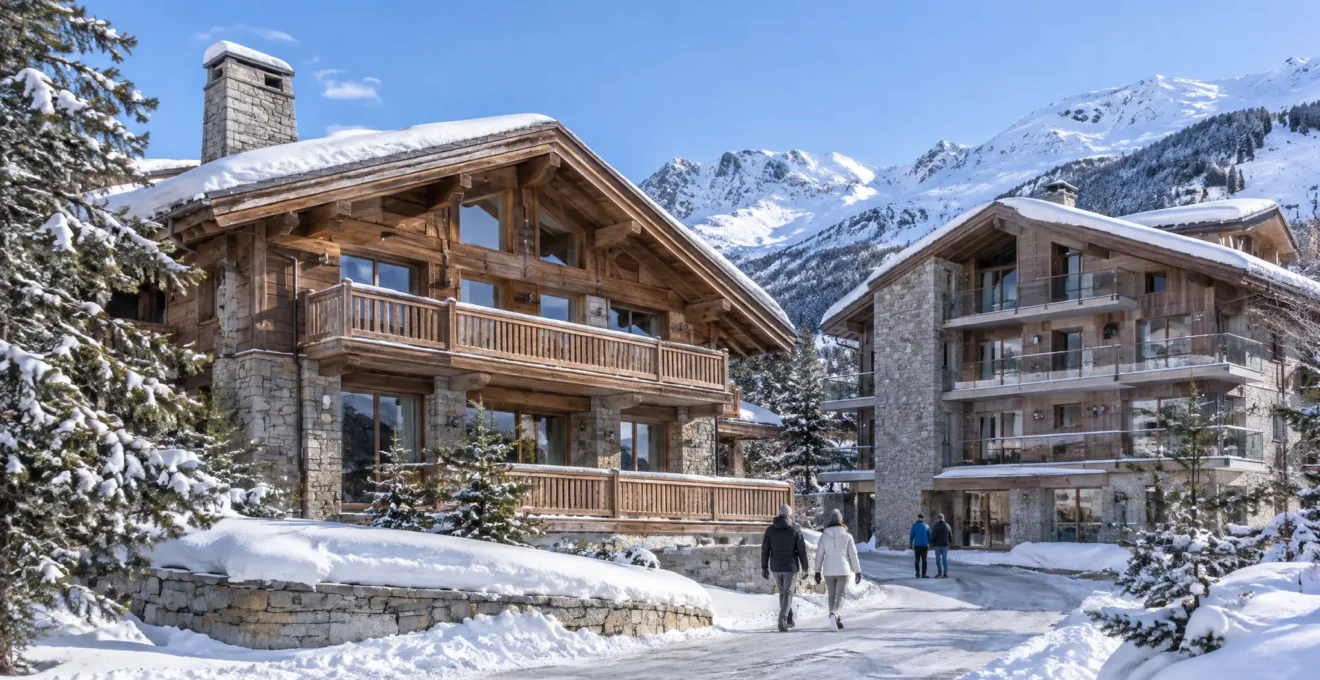
Investing in a Courchevel apartment or chalet can generate seasonal rental income, but strong booking revenue does not automatically translate into a profitable property. The real question is how much remains after management, maintenance, ownership expenses, financing and taxes. Apartments and chalets also have different operating requirements, so neither can be assumed to offer better returns without a property-specific calculation.
A sound investment assessment starts with realistic rental availability, achievable nightly rates and a complete annual expense forecast. It should also account for the weeks reserved for personal use and the French regulations governing furnished tourist accommodation.
Can Rental Income Cover the Cost of Owning Property in Courchevel?
Rental income can offset some or potentially all of a property’s annual costs, but only when realistic booked nights and achieved rates cover operating expenses, ownership charges, financing commitments and applicable taxes. The result must be calculated separately for each apartment or chalet.
The starting point is to distinguish three financial measures:
- Gross rental revenue: the money generated by bookings before expenses.
- Net operating income: rental revenue remaining after the operating expenses attributable to letting.
- Cash flow after financing: the amount remaining after operating costs and actual mortgage repayments, with tax considered separately.
These figures answer different questions. Gross revenue indicates the property’s rental activity, net operating income shows how it performs operationally, and cash flow reveals how much money is actually available to the owner after financing obligations.
For example, an apartment generating substantial winter bookings may still have a weak cash position if its acquisition financing, condominium charges and management costs are high. Conversely, a property with fewer bookings may have a more manageable expense structure. The purchase price, rental schedule and actual annual bills must therefore be assessed together.
Personal use also changes the calculation. Every week reserved for the owner is unavailable for paying guests. Someone who regularly spends several weeks in Courchevel should calculate rental income using the remaining realistically available dates rather than assuming the property can be let throughout the season.
Before estimating returns, buyers need to establish what a property actually offers: its surface area, bedroom configuration, furnishing, condition and location all influence the assumptions used in a financial comparison. Individual altitude-courchevel.com apartment listings provide a starting point for examining these characteristics, which can then be assessed against realistic rental availability and annual ownership expenses.
Apartments Versus Chalets: Different Rental and Ownership Costs
An apartment and a chalet can attract different types of holidaymakers, accommodate different group sizes and require different levels of maintenance. The comparison should therefore cover both rental potential and the expenses necessary to keep each property ready for guests.
| Assessment criterion | Apartment | Chalet |
|---|---|---|
| Purchase characteristics | Surface area, floor, bedrooms, building condition and location | Land, internal layout, usable area, bedrooms and property condition |
| Shared expenses | Condominium charges and collective maintenance where applicable | Property-specific maintenance and any shared access or service arrangements |
| Rental capacity | Actual sleeping capacity and guest suitability | Actual sleeping capacity, group suitability and usable facilities |
| Maintenance | Interior upkeep and potential shared building works | Interior upkeep, heating systems, exterior maintenance and access |
| Operating services | Cleaning, linen, guest reception and management | Cleaning, linen, guest reception and potentially more extensive service coordination |
| Key verification | Condominium rules, charges and property condition | Maintenance records, heating expenses, access and equipment condition |
Apartment ownership: condominium charges and shared responsibilities
Apartment owners should examine the annual condominium statement before estimating profitability. Charges may cover shared areas, building maintenance and collective services. Their amount and coverage vary according to the residence and its facilities.
These costs should not be confused with expenses directly attributable to letting. Cleaning an apartment between guests, replacing linen and managing bookings are separate operating considerations. A building with attractive shared facilities may also have higher recurring charges, so the owner needs to understand exactly what is included.
Condominium regulations deserve particular attention when the property is intended for furnished tourist accommodation. Buyers should obtain the relevant building documents and establish whether any restrictions affect the intended rental activity.
Chalet ownership: heating, maintenance and service coordination
A chalet can offer greater independence and accommodation capacity, but these characteristics do not automatically produce a better financial result. Heating, energy consumption, exterior upkeep, snow-related access arrangements and equipment maintenance all need to be considered.
Guest services can also require more coordination. Depending on the property, owners may need to arrange cleaning, linen changes, key handovers and assistance during stays. If these responsibilities are delegated, the management agreement and associated fees should be included in the forecast.
The important comparison is not simply the number of guests each property can accommodate. It is the relationship between realistic demand, achievable rental rates and the full cost of keeping the accommodation operational.

French Tax and Local Rules That Affect Holiday Rental Income
Rental projections must account for the French rules governing furnished tourist accommodation. These affect both the owner’s administrative obligations and the amount of income ultimately retained.
Understanding furnished rental taxation
In France, furnished rental income generally falls within the bénéfices industriels et commerciaux (BIC) category. Owners may be classified as non-professional furnished rental operators (LMNP) or professional furnished rental operators (LMP), depending on the applicable legal and income conditions.
The applicable tax regime also matters. The micro-BIC regime and the actual regime use different approaches to calculating taxable income. Under the actual regime, eligible expenses and depreciation may be relevant, subject to the applicable accounting and tax rules. The treatment of furnished tourist accommodation can also differ from that of other furnished rentals.
French tax rules have changed, making the income year important. The applicable allowances, thresholds and deductions should be checked against the rules for the relevant year and the owner’s circumstances rather than copied from older examples. In particular, non-resident owners should not assume that their tax position is identical to that of a French tax resident.
The official French furnished rental tax rules explain the applicable administrative and tax framework, including the importance of distinguishing the relevant tax years. The French tax administration also describes the furnished rental tax classification and the general BIC treatment. Its older numerical allowances should not be used as current 2026 thresholds.
Courchevel’s furnished tourist accommodation formalities
There is also a local administrative step to consider. Courchevel’s municipal guidance identifies a declaration requirement for furnished tourist accommodation, together with a SIRET-related registration procedure and applicable tax obligations. Owners should establish the current procedure with the municipality before beginning rental activity.
This check matters even when an agency or property manager handles bookings. Delegating guest management does not automatically remove the owner’s administrative responsibilities.
A Courchevel-specific check: Confirm the applicable municipal declaration, business registration and tourist tax arrangements. Also examine the property’s condominium rules where relevant. Local procedures should not be assumed to be identical across every French Alpine resort.
Tourist tax should be included in the operational arrangements as well. Establish whether it is collected from guests by the owner or an intermediary and how it must be remitted. Do not treat amounts collected on behalf of the local authority as rental income retained by the owner.
How to Calculate the Real Financial Return Before Buying
A useful investment model begins with a complete twelve-month forecast. The same period should be used for rental revenue, operating expenses and ownership costs. This avoids comparing a busy winter season with a full year’s expenses.
Step 1: Estimate realistic rental revenue
Start with the number of nights genuinely available for guests. Remove owner-use periods, maintenance closures and dates when the property cannot reasonably be offered. Then estimate the average nightly rate using comparable accommodation, relevant dates, capacity, facilities and actual booking evidence where available.
The calculation is:
Gross rental revenue = booked nights × achieved average nightly rate.
Advertised peak-season prices should not be applied to every available night. Winter demand can be concentrated around particular holiday periods, while other dates may attract lower rates or fewer bookings.
Step 2: Deduct rental operating expenses
Next, identify the costs incurred to generate rental revenue. These may include:
- Agency or property-management commissions.
- Booking platform fees and payment charges.
- Cleaning, linen and guest preparation.
- Guest reception and assistance.
- Utilities attributable to rental activity.
- Routine repairs, consumables and replacement items.
Net operating income = gross rental revenue − rental operating expenses.
This is an intermediate rental operating contribution, not the owner’s final profit. Deduct recurring ownership expenses separately to assess the annual position before financing. Then deduct actual mortgage payments to assess cash flow, keeping principal repayment distinct from operating costs. Taxable income must be calculated separately under the applicable French furnished-rental tax regime; it is not automatically equal to rental cash flow.
Step 3: Include the full cost of ownership
Recurring ownership expenses may include property tax, any applicable second-home charges, insurance, utilities, internet, condominium fees and routine maintenance. The precise categories depend on the property.
Acquisition expenses, furnishing, renovations and major replacements should also be considered when evaluating the overall investment. They should be recorded separately from recurring operating expenses so that the annual operating result remains understandable.
Financing requires another distinction. Mortgage interest is a financing cost, while principal repayment reduces the outstanding loan. Both affect the owner’s cash position, but principal repayment should not be incorrectly treated as an operating expense.
For this reason, a property can have positive net operating income while still requiring additional cash from its owner to meet mortgage repayments and other financial commitments.
Step 4: Test different occupancy scenarios
A single forecast can hide the risk of weaker bookings. Prepare at least three scenarios using assumptions supported by the property’s location, availability and comparable rental evidence:
- Conservative: fewer booked nights, lower achieved rates or additional operating costs.
- Central: a realistic working estimate based on the available evidence.
- Optimistic: stronger booking performance, without assuming every available night is occupied.
These are planning scenarios, not published Courchevel occupancy averages. Their purpose is to show how sensitive the investment is to changes in demand and operating expenses.
A chalet with higher potential booking revenue may also carry greater heating and maintenance costs. An apartment with lower gross revenue may have a different expense profile. The scenario comparison reveals whether the financial difference remains meaningful when assumptions change.
- Estimate realistically available rental nights after owner-use periods and unavailable dates.
- Multiply booked nights by a defensible achieved average rental rate to estimate gross rental revenue.
- Deduct management, platform, cleaning, linen, utilities attributable to letting and routine repairs.
- Deduct recurring ownership expenses to establish the relevant annual operating position.
- Assess financing cash flow separately, including actual principal and interest payments.
- Apply the appropriate tax treatment after checking the owner’s status and the current tax year.
- Repeat the model with lower, central and higher occupancy assumptions.
Step 5: Check the evidence before committing
The forecast is only as useful as its inputs. Ask for actual expense statements where possible and compare rental assumptions with properties of similar location, capacity, facilities and availability. A general resort-wide estimate is not a substitute for evidence about the property being purchased.
- Purchase price and acquisition-cost breakdown.
- Recent comparable rental evidence and realistic available weeks.
- Condominium regulations and recent service-charge statements, where applicable.
- Property tax and other relevant annual ownership charges.
- Insurance, utilities and recent maintenance invoices.
- Management agreement and commission structure.
- Heating, energy and equipment information.
- Municipal furnished-rental declaration and registration requirements.
- Applicable furnished-rental tax regime and professional status.
- Mortgage repayment schedule and financing conditions.

Make the Decision on Net Costs, Not Headline Rental Income
Investing in a Courchevel apartment or chalet requires more than estimating what a busy winter season might generate. Buyers need to understand the actual rental calendar, the property’s operating requirements, recurring ownership expenses, financing commitments and French furnished-rental obligations.
An apartment may offer a manageable operating arrangement but still carry substantial condominium charges. A chalet may provide greater accommodation capacity while requiring more extensive maintenance and services. Neither characteristic establishes superior profitability without a complete comparison.
The strongest purchase decision comes from a realistic property-specific forecast, supported by actual documents and tested against less favourable booking assumptions. Personal enjoyment can also form part of the decision, but it should remain distinct from rental income and financial return.